Catalia Health
Roles: Product Lead, Research Lead
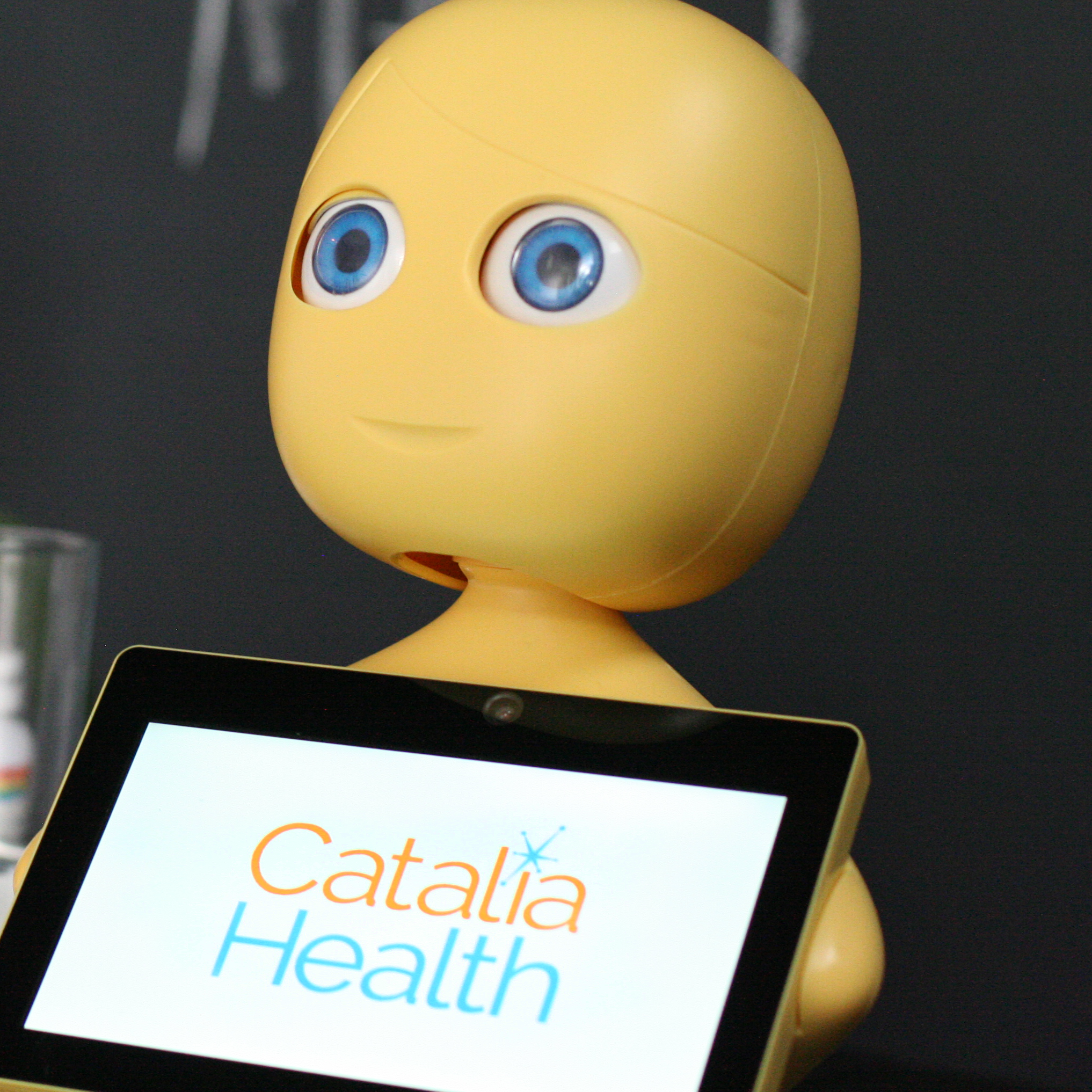
Catalia Health utilizes AI, psychology, and medicine to deliver lasting change for chronic illness patients through engagement with their interactive robotic coach, Mabu. This generates valuable, unique data for customers.
In a randomized, controlled clinical trial, patients using Mabu were engaged 40% longer than those using a computer. Psychological studies confirm people trust, remember, and bond more with in-person interactions, an effect we’ve increased with our technology.
The effective, scalable technology platform and Mabu's AI-driven conversations are tailored to each patient.

The Challenge of Mabu's Portability
Mabu has demonstrated value in patient interaction, but its nature as a physical object limits its use outside the home. Because it isn't easily portable in a purse or backpack, patients cannot engage with Mabu while traveling or simply out and about. The core problem is: how can we extend Mabu's functionality so patients can consistently follow their care plan and connect with providers, even when away from home?

To enhance Mabu's data input capabilities and offer patients a more interactive experience, we developed a dedicated health portal. This platform was designed to allow patients to easily input their medication and health data, as well as monitor their progress over time.

Building on Catalia Health's existing patient research, we conducted a comprehensive study that included a patient survey, a card sort exercise, 1:1 interviews, and industry analysis. These insights collectively confirmed the opportunity a health portal would present to improve patient care.
Patient Insights
We learned through our qualitative and quantitative research that patients fell into two distinct groups:

The Independent Skeptic is a self-reliant DIYer who prioritizes utility over engagement. They reject "smart" device clutter in favor of stable desktop access and demand seamless, on-demand entry to medical records without the friction of personal outreach.
The Open-Minded Explorer is an early adopter who seamlessly integrates smartphones and tablets into their daily routine. They favor low-friction, gamified experiences that prioritize "fun" over cognitive load. This user views healthcare as a dynamic partnership, actively seeking a collaborative relationship with their care team.
Survey Insights
We had 77 respondents all suffering from some form of chronic disease. The survey ran for 7 days.
89% take multiple medications per day
31% forget to take their medication as directed
45% already communicate with their care team via email or a healthcare portal
Quotes from 1:1 Interviews
The ease in communication was cited as a benefit to a portal, but they caution that it must be timely and relevant.
“…I don’t believe I’ve ever received a call from my pain management doctor, unless you count the robo call to remind me of an appointment”
“…I have a lot of stress and remembering my pills adds to that stress, and being stressed makes my...condition worse”
“…best case scenario is that my doctors share my records from office to office, but that doesn’t always happen”
“…usually once a week or so I will forget my second dose of medication.”
“...do they call me? Actually they don’t. It’s up to me to call if anything has changed. They don’t call to check on me.”
“…occasionally I’ve written notes about pain I was experiencing. I tried to describe the pain at those times because it can be very hard to describe certain type of pain...”
The Recommendation
Adopted a device-agnostic, responsive web strategy to ensure inclusive access for both patient groups. By prioritizing a single codebase over a fragmented app ecosystem, we maximized reach and guaranteed content parity across all platforms—from legacy desktops to modern tablets.

Design Ideation
Following iterative design sessions with Catalia Health, we developed designs from low to high fidelity.


Usability Testing

Click to view the Adobe XD prototype in a new window
Validated UX through remote, unmoderated testing with 100% of participants praising the "simple, clean, and easy-to-use" interface. While overall sentiment was high, the study pinpointed a universal high-friction gap: a total inability for all six users to initiate messages from the "Connections" page. Additional refinements focused on nomenclature precision and the integration of a dedicated "Test Results" module.
MVP Design Solution
Postscript
Current Impact: The "clean and simple" architecture successfully disrupts the industry standard of cluttered, high-friction portals.
The Road Ahead: We are transitioning from a validated prototype to a robust enterprise tool, powered by direct co-creation with Catalia Health patients.
Scaling the Ecosystem: Parallel workstreams will kick off to architect the provider-facing experience, mirroring our rigorous, user-centric refinement process to ensure a seamless, dual-sided healthcare platform.
Explore other work